
Multi-Year Utility Bill Review & Rate Optimization
Class I Railway · Multi-Site Electricity & Natural Gas Portfolio, Canada & the United States
This Canadian railway's footprint spans North America, including over 15,000 electricity and natural gas accounts billed under hundreds of utilities, each with unique procurement environments, rate structures, and account spread. Panevo began reviewing these accounts in 2017, starting with a batch of the largest and most impactful ones. No routine verification process existed before that: at that scale, checking every tariff class, demand calculation, and line-item charge against what each account should actually owe was more than any internal team could keep up with.
What began with that first batch of accounts turned into a standing practice: comparing what Panevo knows about how each site actually operates against what it's being billed, then using that comparison to flag rate changes, procurement opportunities, and energy reduction projects as conditions change. Most of the value has come from that ongoing review, not from one-time corrections.
Unoptimized rate tariffs: an account sitting on the wrong pricing tier for its actual usage pattern, which can last for many years unless identified proactively.
Unmanaged procurement: natural gas and electricity supply in deregulated markets left on the default rate rather than actively negotiated, leading to high-cost, high-risk utility supply.
Phantom accounts: metered accounts that haven't consumed any power in multiple years, still billed monthly without verification that the account is necessary.
New account initialization errors: the wrong rate class chosen when a facility was first connected, a component of every bill since.
Misbilling: a meter error, estimated read, or invoice error that generates a one-time saving.
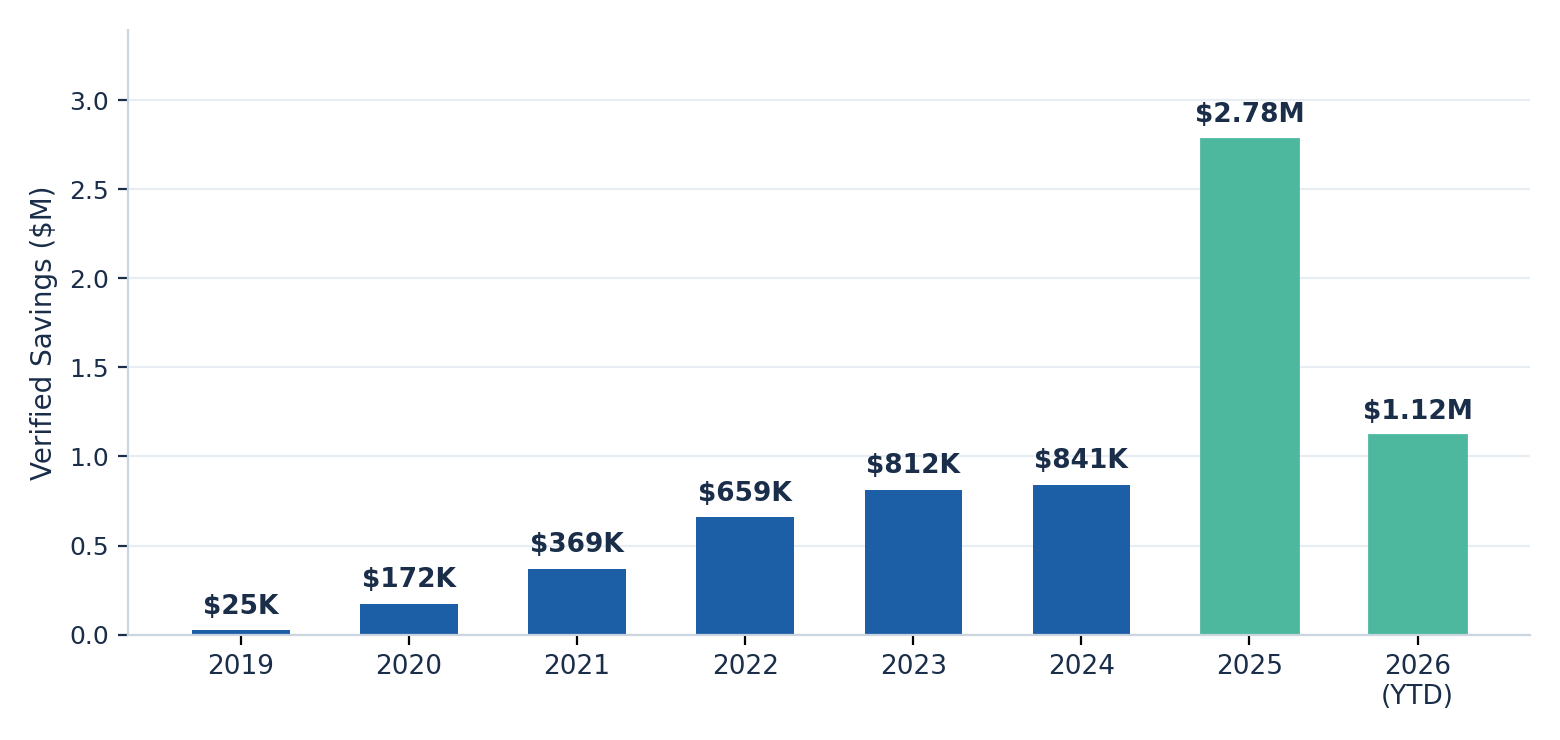
Verified savings by year, 2019 through mid-2026 (partial year). Every year builds on the ones before it, as new measures layer on top of ones already secured.
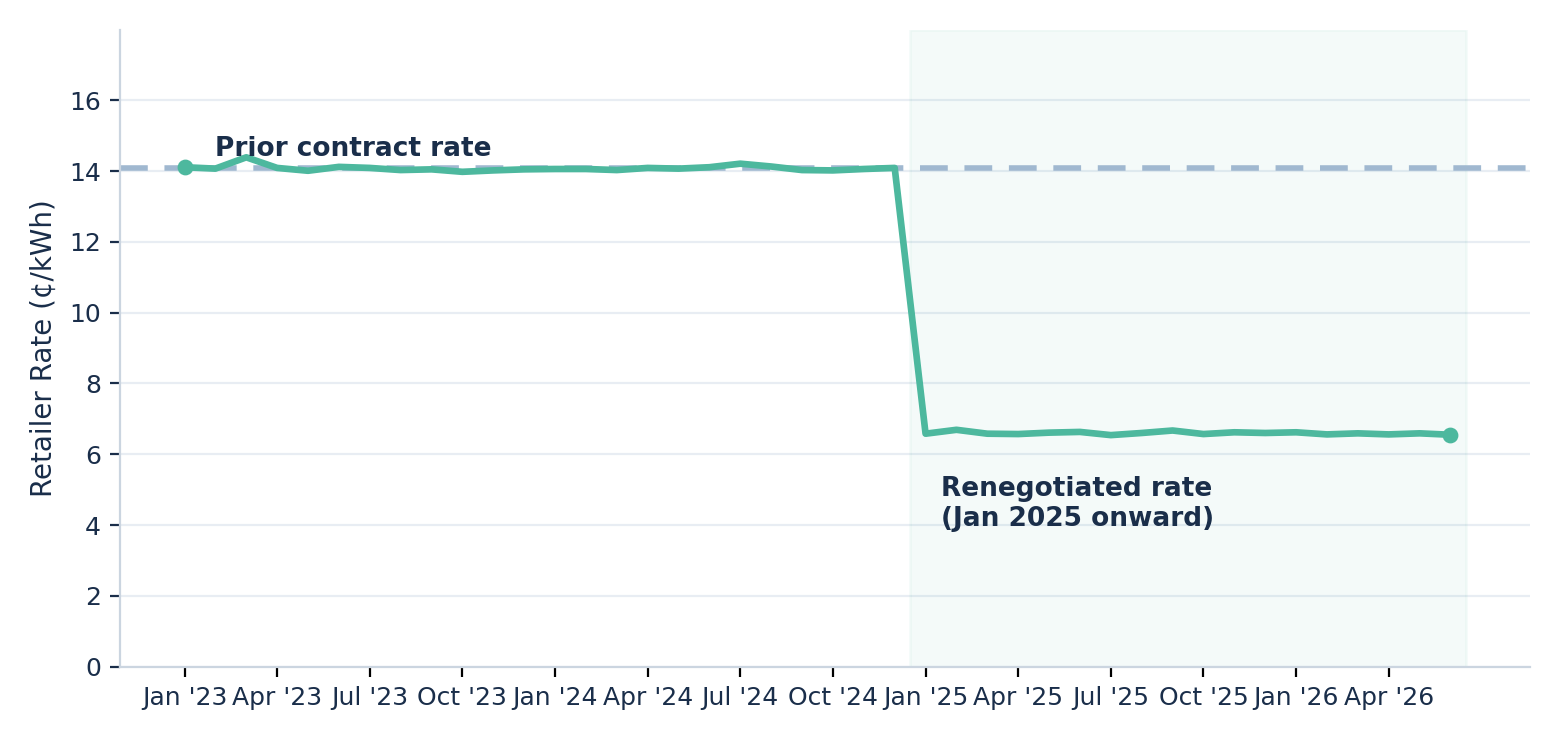
Verified, not projected: this supply contract had gone unmanaged for years, its rate quietly falling behind the market at a flat 14.1¢/kWh. Panevo's renegotiated agreement cut that by 53% starting January 2025, holding every month since and now running at roughly $2 million a year in ongoing savings.
Misbilling: A meter-read error on one account had been overstating its consumption for months before a routine consumption-baseline check caught it and secured a one-time correction worth $160,000.
Unoptimized rate tariffs: Several facilities were sitting on the wrong pricing tier for their actual usage pattern, including two larger sites moved onto a province's demand-responsive industrial electricity pricing structure; corrected, these tariff fixes have returned more than $2.57 million to date.
A new account initialization error: One of the account's largest facilities had been connected to the grid years earlier under the wrong utility rate class for its actual electrical demand, a decision made when the account was first set up that no monthly bill audit would ever have caught on its own. Unwinding cost zero capital, but took a multi-year utility negotiation led by Panevo, returning more than $1.07 million since.
Proactive discovery, still underway: A routine sweep of one province's accounts turned up 72 metered connections billed monthly for delivery service despite recording zero electricity consumption for well over two years; disconnecting them is projected to save ~$85,000/year and is in progress now.
A mistake made at setup, not on an invoice: because the rate class error was made when the account was first connected, fixing it meant renegotiating the account's electrical contract and connection agreement with the utility itself, not just correcting an invoice. That took repeated escalation and engineering analysis of actual facility demand before it was modelled and finalized.
Dozens of separate utility relationships: because the account's bills run through many different distributors and retailers across dozens of jurisdictions, every correction means learning that utility's own tariff rules and building a direct liaison relationship, one at a time, rather than negotiating with a single entity.
From spreadsheets to a living system: the bill database built to review that first batch of accounts in 2017 had to be re-architected, more than once, into a platform that could track a growing account list and new measures indefinitely, work that now lives in Panevo's ioTORQ platform.